
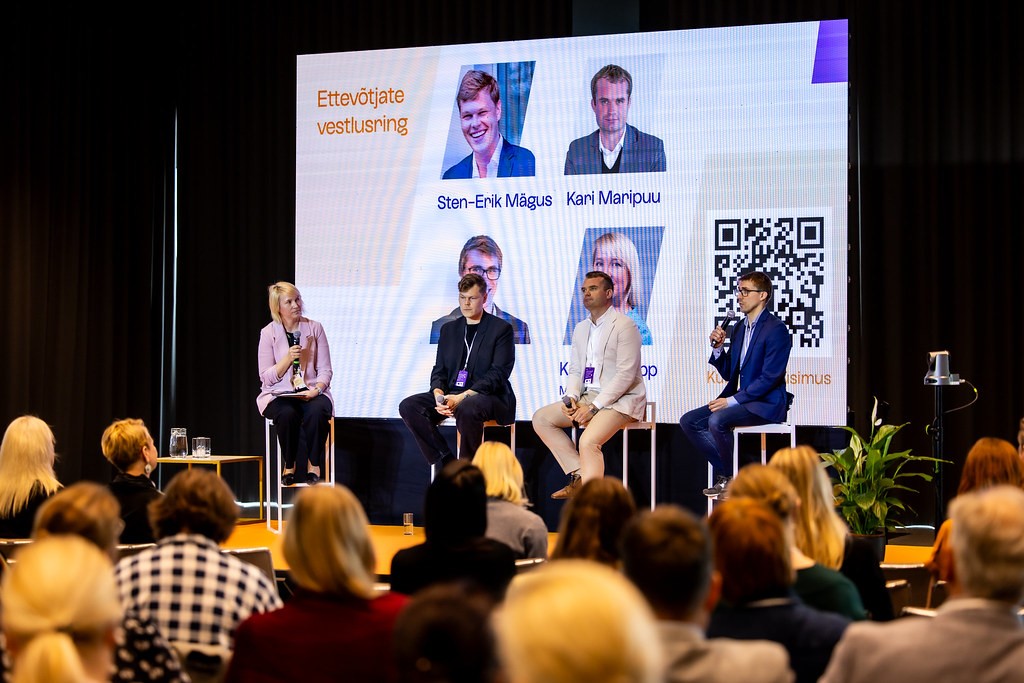
🔗Festival Gallery: https://flic.kr/s/aHBqjCgHfe .
With Estonia’s population ageing rapidly, demand for quality health and care services is steadily increasing alongside a growing shortage of personnel able to deliver these services. “This is a challenge we can no longer ignore,” said Kitty Kubo, Lead of Innovation and Technology in Social Care at Estonia’s Ministry of Social Affairs.
“Fortunately, there are many proven technology solutions already available in the market that can support older adults and other people in need to maintain independence, as well as alleviate pressure on Estonia’s health and care system,” Kubo explained.
According to Kubo, nearly half of Estonia’s population aged 65 and over live alone. More than two-thirds of these people have a long-standing illness or health problem, with a quarter experiencing significant limitations in everyday life. “Today, older people in need often end up in care homes without having received any prior support services at home. Care homes are neither people’s preferred choice nor cost-effective for families or for the society. We must focus instead on using technology-enabled homecare to prevent or postpone the need for institutional care,” Kubo said. “This new innovation programme is designed specifically to encourage public sector’s collaboration with providers of technology solutions and researchers across health and care systems in developing smart digital solutions and remote care models.”
The national welfare technologies innovation programme has a budget of approximately €12 million, with the first round of applications set to open this autumn.
Kubo emphasised that the programme would focus on technology adoption gap by accelerating the adoption at scale of existing technology-based solutions rather than developing new ones. “Experience shows that the greatest challenge lies not in technology, but in the ability to manage the process of complex change to realise the potential benefits of technology in real practice. They are therefore more than just IT projects,” she stressed.
In a festival workshop run by Daniel Kotsjuba, head of Social Design Master’s studies at the Estonian Academy of Arts, participants reflected on whose viewpoint shapes new solutions, and how well we actually understand the context in which the services we develop are being used. “We raised crucial questions: do we genuinely understand the user’s situation? Are we creating solutions based on our own assumptions or addressing real people’s actual needs? Solutions must be human-centred and genuinely solve the problem faced by the end-user,” said Kotsjuba.
Professor Christine Gustafsson of Sweden’s Sophiahemmet University stressed during her session that adopting new welfare technologies requires more than technical innovation—it demands a fundamental shift in thinking and operational practice. “To ensure successful implementation, organisations need to consciously set up conditions for change,” Gustafsson said. “Before introducing new solutions, it’s essential to analyse how your organisation can manage such changes effectively. We offer a structured approach highlighting key elements and providing guidance on overcoming potential barriers, ensuring both staff members and users embrace the new technologies.”
“We want successful, proven solutions to become widely adopted.” /Kitty Kubo/
The innovation programme seeks ideas and project teams interested in developing and implementing novel, user-oriented technology enabled solutions.
In the programme’s initial phase, selected teams will receive innovation support and seed funding for a short development sprint of a few months, allowing teams to validate ideas, engage right stakeholders and design service models. Projects successfully passing this initial phase may apply for larger financial support to pilot and evaluate the benefits of the solutions in real-world settings over a longer period.
The Welfare Technology Festival brought together more than 200 health and social care policymakers and professionals, researchers, service providers and technology companies. Its exhibition area showcased 20+ existing welfare technology solutions that are already able to support people in need. Workshops were led by academic experts Christine Gustafsson of Sophiahemmet University, Kadri Leetmaa of the University of Tartu, Daniel Kotsjuba of the Estonian Academy of Arts, and Kadi Lubi of Tallinn University of Technology.
The event was co-funded by the European Union’s Cohesion Policy 2021–2027 programme "Improving the availability and quality of long-term care".

